
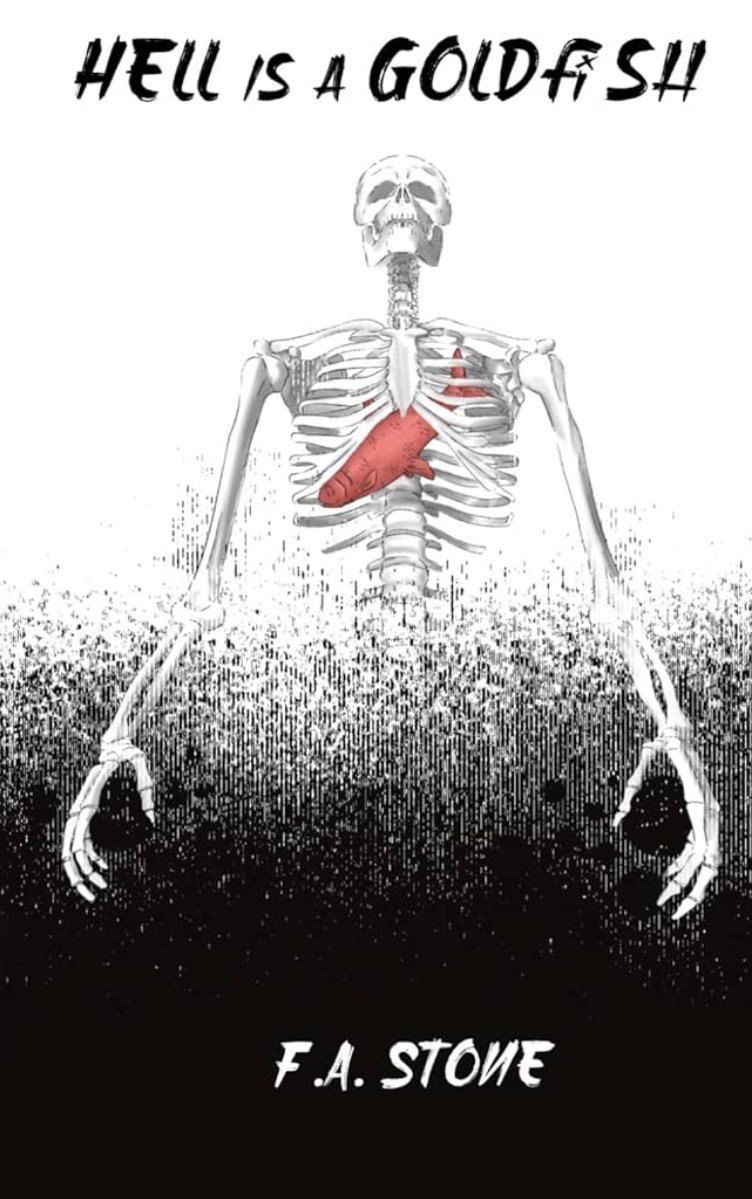
(Gold) Hell is a Goldfish
Author: F.A. Stone Category: Gold (3 stars) Publisher: Independently published Published: November 22, 2025 ISBN: 979-8271726002 More Details‘A novel that knows it’s a novel and isn’t particularly pleased.’
Hell is a Goldfish has earnt a Gold Badge (3 Story Stars) with a score of 4.25, due to its excellent characterisation, outstandingly original concept & theme, and consistently strong craft throughout the book.
A Gold Badge represents a prestigious distinction reserved for great books that demonstrate excellence in multiple areas, alongside consistent strength across all aspects of craft. This recognition is reserved for books that are crafted with care, skill, and thoughtfulness at a notably high level.
Each craft category is sorted into a band 1-5, with 5 being the highest score awarded and 1 being the lowest. Most of our ratings sits between 2-4 with Band 5 or Band 1 given only with substantial evidence. Hell is a Goldfish has scored:
- Narrative Craft: 4 (Strong)
- Prose: 4 (Strong)
- Character: 5 (Exceptional)
- Dialogue: 4 (Strong)
- World & Atmosphere: 4 (Strong)
- Concept & Theme: 5 (Exceptional)
- Format: 3 (Competent)
Main Review
Hell is a Goldfish is an inventive and deeply self-aware novel that blends satire, absurdism, and meta-fiction into a commentary on meaning, mortality, and the act of storytelling itself. From the outset, Hell is a Goldfish, announces its intentions with a non-traditionally structured prelude and trio of prologues. These prologues frame the existential force of the Goldfish that underlines the book, each one setting a tone that we’re in for an experience that’s playful, strange, and philosophical.
The story follows the initially unnamed protagonist, soon to be named Luke Glass, who gains consciousness in an empty void and quickly accumulates the components of existence: movement, memory, objects (or more fittingly, object), and companionship. This construction lays out one of the book’s themes: mirroring human sentience, with Luke reaching ‘adulthood’ and soon growing impatience with the meaninglessness of life trapped within an endless void. All of this is delivered through strong, cynical, and character-driven prose. His relationship with Red, an endearing red-herring, underlays much of the story, and helps add humour, tension, and an exploration into Luke’s psyche.
As the novel progresses, Luke is subjected to a series of surreal, constructed realities by enigmatic Dr Deus. These sequences are imaginative, absurd, and thematically rich, though occasionally favour the conceptual over clarity. As we reach the final act, Hell is a Goldfish dives fully into its meta-fiction ambitions: openly discussing its own construction, literary devices, and the role of the author and reader, which accumulates in an impactful closing chapter. All this occurs as Luke realises that the wider universe is not all that it’s cut out to be.
The prose is confident and witty, supported by inventive footnotes that blur the narrative boundaries. Minor formatting issues sometimes interrupted the book’s flow, but Hell is a Goldfish’s originality and execution of theme and concept make this book a fantastic read we fully recommend.
Strange, funny, and unapologetically experimental, Hell is a Goldfish will leave you questioning what a book really is.
Full Craft Review:
Narrative Craft (22%) – Awarded: Band 4
The narrative of Hell is a Goldfish is well constructed and largely effective in creating reader engagement and supporting the novel’s meta-fictional design. From the beginning, Hell is a Goldfish establishes itself as deliberately unconventional through its prelude and three prologues. The prelude, which alludes to the story existing within a hologram (a hologram set within The Holy Hologram’s Universe), immediately introduces a sense of strangeness and intrigue, both to the reader who is familiar with F.A. Stone’s wider universe and those encountering it for the first time. The three prologues further reinforce this tone, each offering a distinct and unusual approach that collectively establish the book’s central conflict and symbolism: the Goldfish. This ranges from the definition of a goldfish, to introducing the act of ‘the goldfish absorbs’, to the unsettling, unconventional block of text. These openings set Hell is a Goldfish immediately on the right path.
The beginning stages of the narrative work in tandem alongside the protagonist, Luke Glass’, discovery of existence. He starts the book gaining consciousness in a void of nothing, then gains movement, then experiences memories, then gains a body, before, at last, he develops a friend through the character of Red. Red’s introduction arrives at a natural point in this progression and at the right time that the narrative needed a secondary character. The momentum doesn’t stop there, as an object is introduced to the void (the lampshade), which is followed by love, hate, and forgiveness between Red and Luke, before at last, Luke is thrust into a world beyond the void. This gradual accumulation of different experiences creates a sense of forward momentum and supports the novel’s themes of meaning and living as he loosely mirrors human sentience, while also reinforcing the meta-fictional idea that the book itself is developing more and more as it unfolds.
Once these foundations have been established and Luke and Red have existed within the void for several eternities, the narrative turns to Dr Deus (who works for The Man in the Orange Chair), as he forces Luke to undergo three realities all so that by the end he will submit to the Goldfish. This narrative shift occurs at an appropriate moment, before void becomes narratively static. Each of the three realities themselves reinforce the novel’s absurdist tone and focus around the now named, Goldie, the Goldfish, as a character beyond just a symbolic presence. However, these sequences do hold the book back from Band 5, due to a need for a clearer sense of plot-purpose of each reality as well as stronger visual grounding. That said, these scenes have many strengths: such as showing the weird, unsettling nature of Goldie, and helping to progress Hell is a Goldfish’s commentaries on life, death, and what is a novel?
After these scenes, the final half of the book leans fully into its absurdism and meta-fiction to create brilliant narrative scenes: from the climatic interview with Dr Deus, to the highly anticipated meeting with The Man in the Orange Chair, to the appearance of gun-wielding Chekhov (who’s appropriately set up earlier in the book!), to Luke’s life alone. In this section, Hell is a Goldfish, also discusses in-universe the book’s own creation, such as a commentary on its cover, which was highly amusing. However, Hell is a Goldfish could elevate to a Band 5 by fully capitalising on Luke’s experience now he’s fully out of the void and in the wider universe. While the intention was there, in execution Luke’s life beyond the void and Red felt that it was missing the impact that it could’ve had.
The ending of Hell is a Goldfish does an excellent job at drawing together the novel’s meta-fictional themes, as in the final chapter, Luke calls out to the Goldfish, to the author, and to the reader themselves, dismantling the final barriers of the book which leaves a lasting impression on the reader.
Overall, tension is maintained well throughout Hell is a Goldfish, with the Goldfish functioning as a constant, looming presence throughout the narrative. Meanwhile, The Man in the Orange Chair, is excellently foreshadowed and his appearance is well-executed. The subplot involving robot Red adds a fascinating element of intrigue, though we feel this subplot could’ve been more prevalent and concluded more thoroughly and clearly. Hell is a Goldfish’s narrative places itself firmly in Band 4 through its well-crafted structure and plot beats.
Prose (18%) – Awarded: Band 4
The prose of Hell is a Goldfish is sharply character-driven from the cynical and deeply human perspective of the protagonist, Luke. It’s often very funny, matching the novel’s absurdist tone, while also commenting on philosophical meaning in a tongue-in-cheek way that make the commentary more natural, palatable, and impactful. The prose will often make sharp, self-aware commentary on a situation, either through Luke’s voice, or through the footnotes which shift between Luke and what can be assumed to be the Man in the Orange Chair, sometimes in a dialogue. These footnotes are an effective stylistic device, as they add context to a situation or help express character’s frustrations or feelings, especially since they mostly offer perspectives from the future. The choice to use footnotes reinforces Hell is a Goldfish’s meta-fictional structure and allows the prose to comment on itself. However, the prose is held back from Band 5 by moments where the footnotes become overwhelming, particularly in the latter part of the novel. The footnotes justifiably grow in intensity alongside Luke’s growing anger at the universe, but near the end this intensity can occasionally feel clumsy or overly dense rather than sharply integrated into the narrative flow. While the choice of anger at this stage at the book is fitting for where Luke has reached in the story, we would like it to be more smoothly integrated to reach the highest band.
Hell is a Goldfish utilises first person POV to an excellent extent with its distinctive character voice. Luke feels fully realised through the prose and his voice shapes how the prose itself is written, which help not only to make the prose engaging but also shape Luke as a deeply complex and realistic character. The prose fully integrates his thoughts into the book’s observations, with the world only being perceived through his eyes. To reach the highest band, the prose could use some tighter control in places, such as trimming some unnecessarily word phrasing. As it stands, the prose remains strong, engaging, and thoughtful which comfortably justifies its Band 4 placement.
Character (18%) – Awarded: Band 5
The characters in Hell is a Goldfish are excellent. They are thoughtfully constructive, purposeful, and consistently engaging, with each one of them feeling alive. The protagonist, Luke Glass, shines throughout the book, supported by the already mentioned character-driven prose that crafts him as an emotionally complex human being. His character arc throughout Hell is a Goldfish is strong and substantial. We clearly see his development, especially in relation to his thoughts of Red where we see his frustrations twist and change from love to hate to love in ways that feel deeply realistic for someone stuck with only one person (or fish!) for eternity, culminating to his final act of anger to Red. Red’s characterisation is brilliantly contrasted to Luke, whose childish naïveté clashes with Luke’s cynicism, and his ‘simplicity’ is clearly shown as the cause for Luke’s growing anger.
The Goldfish, or more specifically Goldie herself, is another brilliant character. She fully embodies the novel’s absurdist themes, particularly within the ‘three lives’ scenes where she features in each one as totally bizarre and unknowable. But the character of the Goldfish does not stop with Goldie, but is encompasses multiple meanings, including people themselves, with multiple other characters mentioned fleetingly (appropriate for the theme of a goldfish), including those associated with the creation of this very book. These layered interpretations of what the goldfish character means, add much more layers to this already thought-provoking book.
Finally, it would be remiss not to discuss the Man in the Orange Chair, who brilliantly encapsulates the book’s meta-fictional elements (in more ways than one). The concept of his character is unique, funny, and thoroughly enjoyable to read. He is effectively foreshadowed as a mysterious, powerful figure, only to reveal himself as strikingly ordinary and as normal as you and me, which is very fitting considering who he’s revealed to be. The conversation Luke had with the Man in the Orange Chair was also deeply amusing, impactful, and effective in its meta-fictional execution. Overall, the characters are deeply thoughtful, realistic, and impactful.
Dialogue (13%) – Awarded: Band 4
The Dialogue in Hell is a Goldfish reinforces Luke’s strong character voice. His cynical attitude and observation shine through the dialogue, often carrying the same dry wit as the prose and serving as an extension of his internal narrative. His conversations bounce off the supporting characters naturally such as Red, whose dialogue effectively captures his child-like excitement and is appropriately distinct to Luke’s. The dialogue is great at portraying character and at no point does the dialogue feel flat or similar from character to character: from Chekhov’s gruffness, to Goldie’s absurdism, to Dr Deus’ own strangeness, to the ordinary (and dare I say eccentric) Man in the Orange Chair.
Overall, the dialogue functions well at progressing the story and expressing character and gives scenes a strong sense of rhythm. That said, the dialogue is held back from a Band 5 due to some of the same limitation found in the prose, as while it’s competent and engaging, to reach a higher level we would want the dialogue to carry sharper insight and more emotional subtext. However, the dialogue is thoroughly in Band 4: well-crafted, character-driven and effective.
World & Atmosphere (12%) – Awarded: Band 4
The world and atmosphere in Hell is a Goldfish are both creative and unique. In the first act, we spend most of our time in a void, which some might think would be bland. However, Hell is a Goldfish, plays with this empty space, bringing us into the entrapment and lack of meaning. When an object does arrive in the form of the lampshades, they’re used creatively and vividly and quickly make the void of Hell is a Goldfish feel like it occupies space despite the fact it’s nothingness. As the story progresses, the world of Hell is a Goldfish expands beyond the void to the wider universe. The scenes Dr Deus throws them in are all varied and each capture a different tone which is fitting to the reality Luke is thrown in. Each of these three scenes plays with the idea of place, and how a story is impacted by a new setting.
Hell is a Goldfish also makes reference to the author’s wider world of The Holy Hologram, with hologram passages interspliced throughout the book. However, while they give the book a sense of richness to someone familiar with The Holy Hologram world, they feel somewhat confusing to those who are not. To reach a Band 5 we would want these sections to work towards more of a distinct end goal or purpose, even if vague, within the contained story of Hell is a Goldfish, so that a reader can understand why they’re included beyond just reference to the overall series. While Hell is a Goldfish’s worldbuilding is intriguing, the book doesn’t quite reach Band 5 due to a lack of clarity of location and missed opportunity in Act 3. Despite Act 3 being within a wider universe, the sense of where Luke is in the universe and how this universe manifests feels vague and somewhat confusing and the tone of the space Luke inhabits feels lacking compared to Act 1. But, overall, World & Atmosphere is well executed and earns a Band 4.
Concept & Theme (12%) – Awarded: Band 5
The concept and themes of Hell is a Goldfish are phenomenal: the book is highly original and executed with exceptional clarity and purpose. The book’s concept – a meta-fictional commentary of a man in a void then exploring the wider universe – is a rarity and its execution is just as inventive and thoughtful. The book uses structure throughout to elevate its concept.
Hell is a Goldfish satirises fiction and the concept of the novel itself, this it does excellently through the literary references woven into the very pages, that are both fun to spot and are extremely creative: from Red as a red herring, Chekhov himself, saving a cat, and many more. But the book’s themes go beyond just that reading, turning its criticism of meta-fiction to a commentary on life instead and on its meaning: interrogating existence, authorship, and mortality. The concept of the Goldfish is highly original in itself and intelligent as it captures multiple layers of meanings from different examinations of the book: from a symbol of death or even a black hole as it constantly consumes life, to the very divider to each chapter, to goldfishes being used to represent lives and people themselves, whose life are fickle and fleeting in the grand scheme of the universe and serve as a complete contrast to the ever-immortal Goldfish. Hell is a Goldfish feels one of a kind and incredibly thematically focused.
Format (5%) – Awarded: Band 3
The formatting of Hell is a Goldfish is generally functional and is appropriately laid out. While the prose is clearly laid out, there are noticeable technical errors which interrupt the flow of reading. These including spacing issues, spelling inconsistences (such as “theif” instead of “thief”), formatting inconsistencies (such as the use of both “DND” and “D&D” in the same page), and several punctuation errors, including missing full stops/periods at the end of the paragraph, particularly after speech. While none of these issues derailed comprehension, their presence is frequent enough they create moments of distraction that pull a reader out of the experience. These errors do not seem from a lack of understanding but rather have been missed during editing. As a result, the formatting sits comfortably at Band 3: competent in execution but held back by understandable but noticeable, technical oversights